Collective Effervescence
Why communal experiences matter more than ever.

I am an absolute sucker for a lone bagpiper in the distance playing Scotland the Brave.
Seven Nation Army echoing through a football stadium.
Singing Thunder Road at the top of my lungs with 50,000 other people at a Bruce Springsteen concert.
Wagner’s Bridal Chorus at weddings.
The shared ohms at the end of yoga class.
A marching band rounding the corner.
And especially graduations.
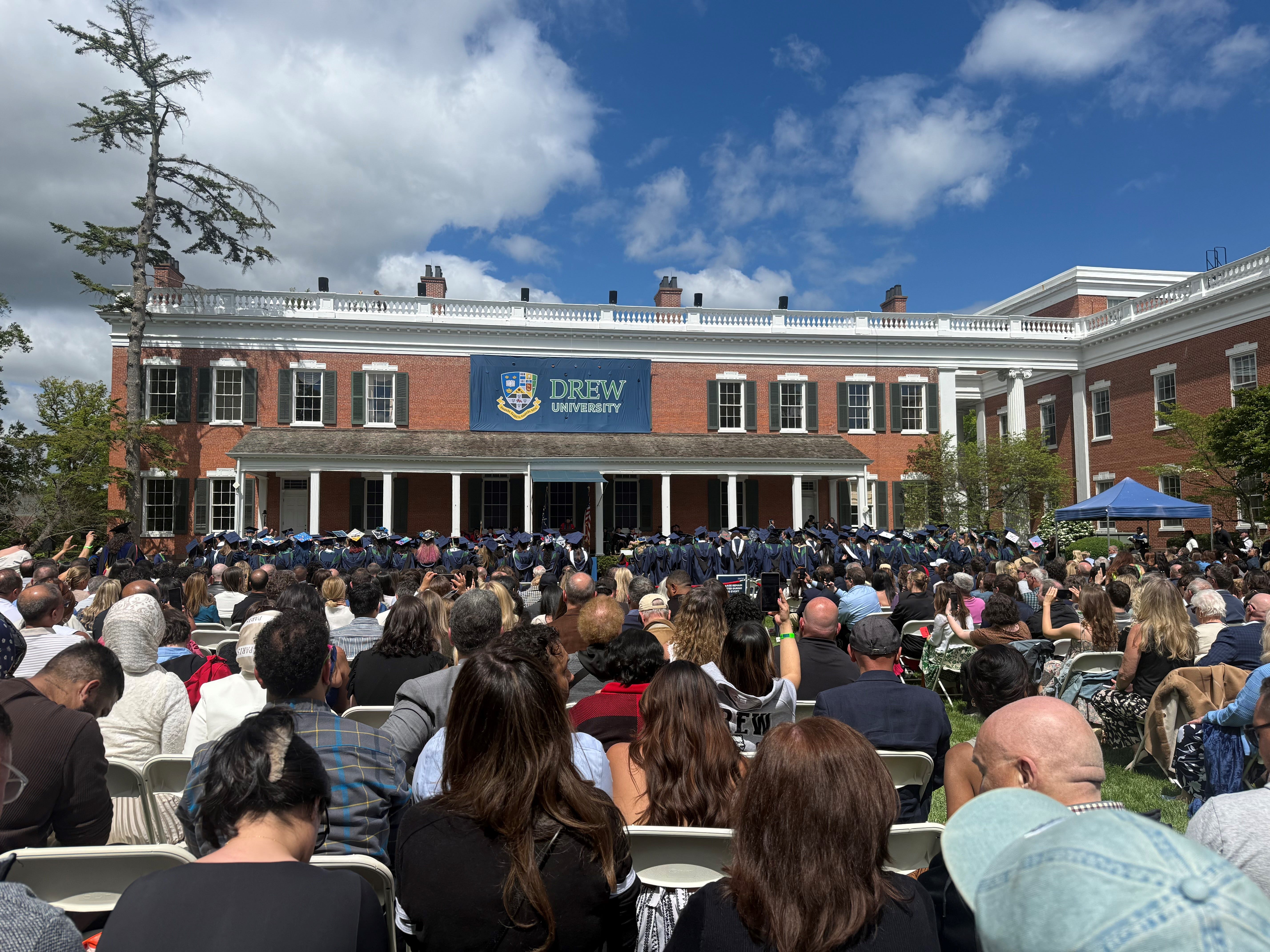
Last Friday, I watched my niece Madelyn graduate from Drew University in Madison, New Jersey. It was chilly and overcast outside. Gray skies. Heavy air.
And yet somehow, it felt sunny and warm in my heart.
The second I saw the graduates in their black robes marching in the distance, the waterworks started.
Honestly, Madelyn did not even need to be graduating for my emotions to kick up. There is something that happens in my body when I find myself in these kinds of settings. My mom quietly handed me tissues while I hid behind oversized sunglasses, slightly embarrassed by the intensity of my own reaction.
The thing is, I would not describe myself as especially emotional.
Emotionally attuned? Yes.
Deeply feeling? Absolutely.
But openly weepy at public ceremonies? Not usually.
So, this recurring experience made me curious.
Back in 1912, the sociologist Émile Durkheim coined the term collective effervescence to describe the electric feeling of energy, harmony and connection that happens when people gather around a shared purpose or experience. For a brief period of time, individuals step outside themselves and become part of something larger.
The second I read the phrase, I practically yelled:
THIS IS SO ME.
Because I know this feeling intimately.
I felt it Friday at graduation while listening to commencement speaker Marc Freedman talk about purpose, contribution and the human need to matter to one another.
Referencing Wendell Berry, he asked:
“What is the need that needs you the most?”
He encouraged graduates to put together the two things uniquely theirs and use them in service of the world.
It felt like another version of the same idea:
our lives become larger when we connect ourselves to something beyond ourselves.
Then later, Yeongrok Choi, one of the graduating divinity students, stood up and sang Defying Gravity completely a cappella and perfectly on pitch. Within seconds, the audience joined in. Later in the ceremony, the Drew choir sang “Widen the Circle” and again, the crowd sang together.
Hundreds of strangers.
One emotional organism.
Maybe that’s also why singing together has always mattered so much in human communities.
Religious services include singing.
Protest movements include singing.
Concerts do too.
One of the fastest ways to turn strangers into a community is to have them raise their voices together.
I felt it at Broad Street Run this year too.
At a Glen Hansard concert.
During the annual July 4th karaoke party with my neighbors on 31st Street.
And during leadership programs when something shifts in the room and people stop acting like coworkers and start feeling like a community.
These experiences remind me of aspen trees.
What looks like individual trees standing alone is often one massive interconnected organism underneath the surface, communicating and supporting itself through an elaborate shared root system.
Humans are not so different.
I think modern life has made us forget this.
We work from home.
We stare at screens.
We consume individualized algorithms.
We text instead of gathering.
We substitute information for experience.
And yet the second a crowd sings together, rises together, runs together or grieves together, something ancient switches back on.
Life suddenly feels larger than ordinary life.
I think great leaders understand this intuitively, whether they can articulate it or not. Great communities do too.
People do not only need information, strategy and efficiency.
They need resonance.
Ritual.
Shared emotional experience.
The feeling of being part of something beyond themselves.
Maybe that is partly why I keep creating spaces where people gather and feel together.
To widen the circle, if you will.
Especially if there’s a bagpiper.
Cindy, you are such a gifted writer, thanks for sharing your gifts with this community! Your writing brings out the emotion in this enneagram type 2; I so appreciate your thoughts on community and the importance of being in community during this technology driven season of life. Also, your thoughts on “the shift” that occurs in leaders when they stop being co-workers and start being connected with one another really landed you.
Keep writing Cindy, it’s such a gift!!
I love this. NYU’s Jonathan Haidt uses the term “the hive effect” to refer to the same thing. Biologically, he says, we’re 90% chimp—individualistic—but 10% bee—capable of melding in purpose and experience with others.