The Return
Ten miles, one year later

Maybe LL Cool J was wrong.
It was a weekend for comebacks.
Golden Temple.
Joel Embiid and the Sixers.
And, improbably, me.
Ten months of coming back to myself.
I cried in the last mile of the 2026 Broad Street 10 Miler.
Tears of joy. Relief. Pride.
That’s not where this story starts.
In all honesty, I nearly didn’t make it to the starting line.
Last year, after the worst Broad Street Run of my life, I quit.
Four miles. Total.
That’s all I ran between BSR 2025 and November.
I’ve included the piece I wrote after that race below. It’s written from a pretty exposed place.
At the time, I never imagined it would see the light of day.
I remember sitting down and pouring my ache onto the page.
Raw. Hurting. Ashamed.
It took me a long time to reckon with what actually bothered me most:
Not the race.
How I turned on myself during it.
I couldn’t find a friend within.
And I never wanted to put Monica — my best friend and running partner for over a decade — or myself through that again.
Last August, I got honest.
I wasn’t doing well.
On the outside, you might not have known.
On the inside, everything was cracking.
My coping mechanisms — the ones that used to work — stopped working.
Sugar. Booze. Running. Reading. Doomscrolling.
I was trying to outrun my emotions.
I couldn’t.
Self-loathing and shame got louder instead.
And the irony wasn’t lost on me: I spend my life helping other people navigate themselves.
Meanwhile, I was stuck.
Being a 54-year-old woman will humble you. Your body changes whether you’re ready or not.
I wasn’t ready.
But I was out of options.
So I did something I encourage others to do all the time:
I asked for help.
I built a team.
My primary care doctor took me seriously. We looked at my baseline and started supporting my body — hormones, a starter GLP-1 dose.
I found a new therapist and actually started talking about how I felt.
Not what I thought about things.
Not the analysis.
The feelings.
That’s harder for me.
I stopped drinking.
Perhaps not forever. But for now.
It wasn’t working. The hangxiety alone was enough to call it.
August 13.
That’s the day I said goodbye to the version of me that got me through the last seven years.
She was a warrior.
And she was exhausted.
In November, after weeks of long walks with no pressure, I had a thought:
I wonder what it would feel like to run a mile.
So I did.
One mile became two.
Then a light Runna plan.
Then something shifted.
I started to look forward to running again.
My mind got quieter. Kinder. Safer.
Somewhere along the way, I made a decision:
I was going to get back to the Broad Street starting line.
Not to prove anything.
Just to show up differently.
Between November 2025 and May 2026, I ran 454 miles.
Most of them felt… good.
Not performative. Not punishing.
Just good.
I didn’t take them for granted.
I thought. I processed. I worked things out.
Without numbing. Without noise.
Writing came back.
An old friend.
Turns out, sobriety is a little boring at first too.
But it makes space.
And space changes things.
I added the Love Half Marathon in March.
I was ready.
Not perfect.
Ready.
BSR race day.
Cold. Tailwind. Ideal conditions.
But what struck me most was this:
I got to be there.
After everything, I made it back.
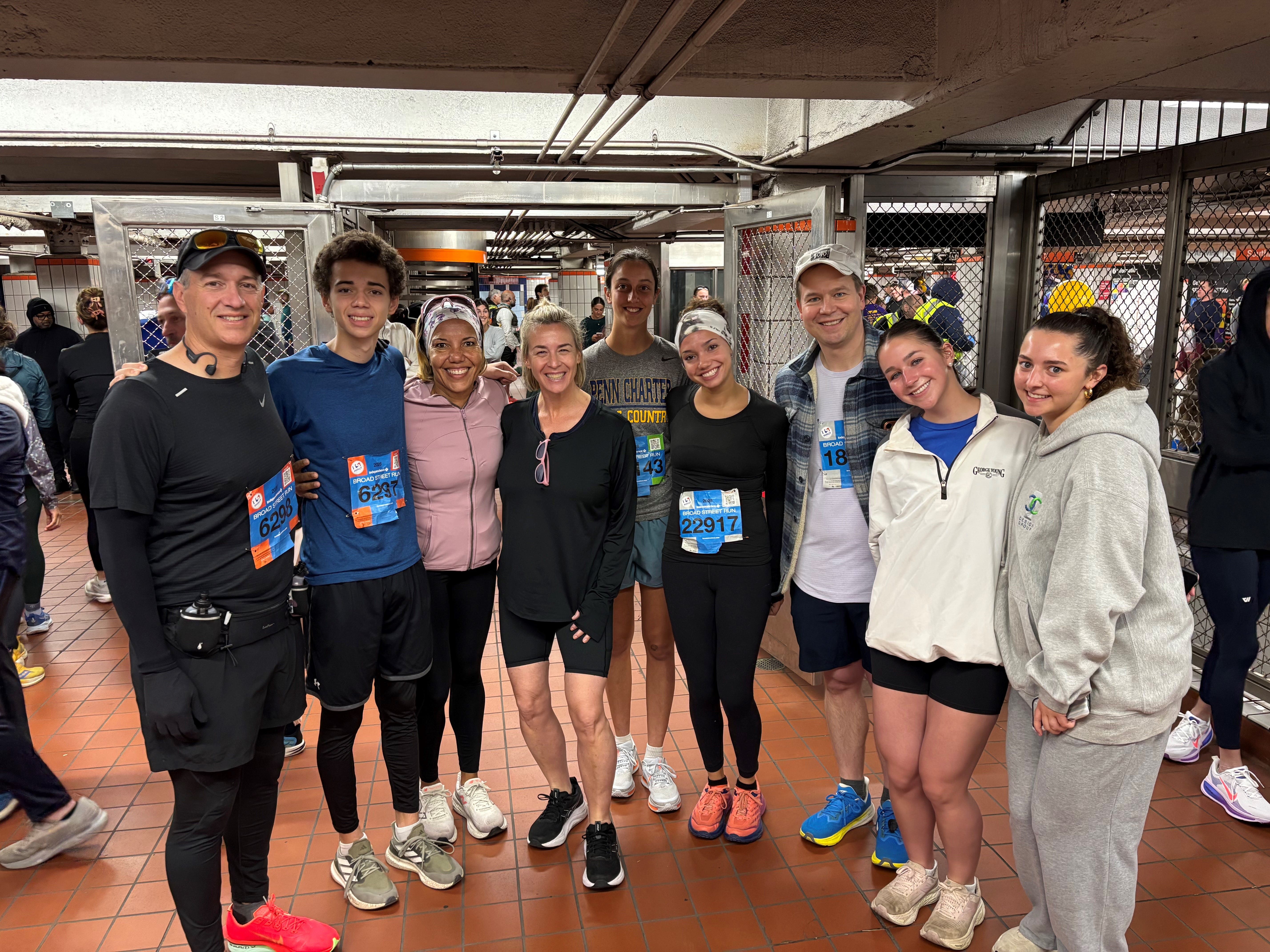
I ran with Monica.
Ten years after our first Broad Street together.
Now her husband and kids were with us. Her son’s first race. Her daughter’s second.
My friend Dan, his daughter and her friend joined us at the start for a second year too.
Time does that. Expands things.
I took it all in.
The costumes. The signs. The chaos. The joy.
“The country of Philadelphia,” as the locals say.
People showing up for each other.
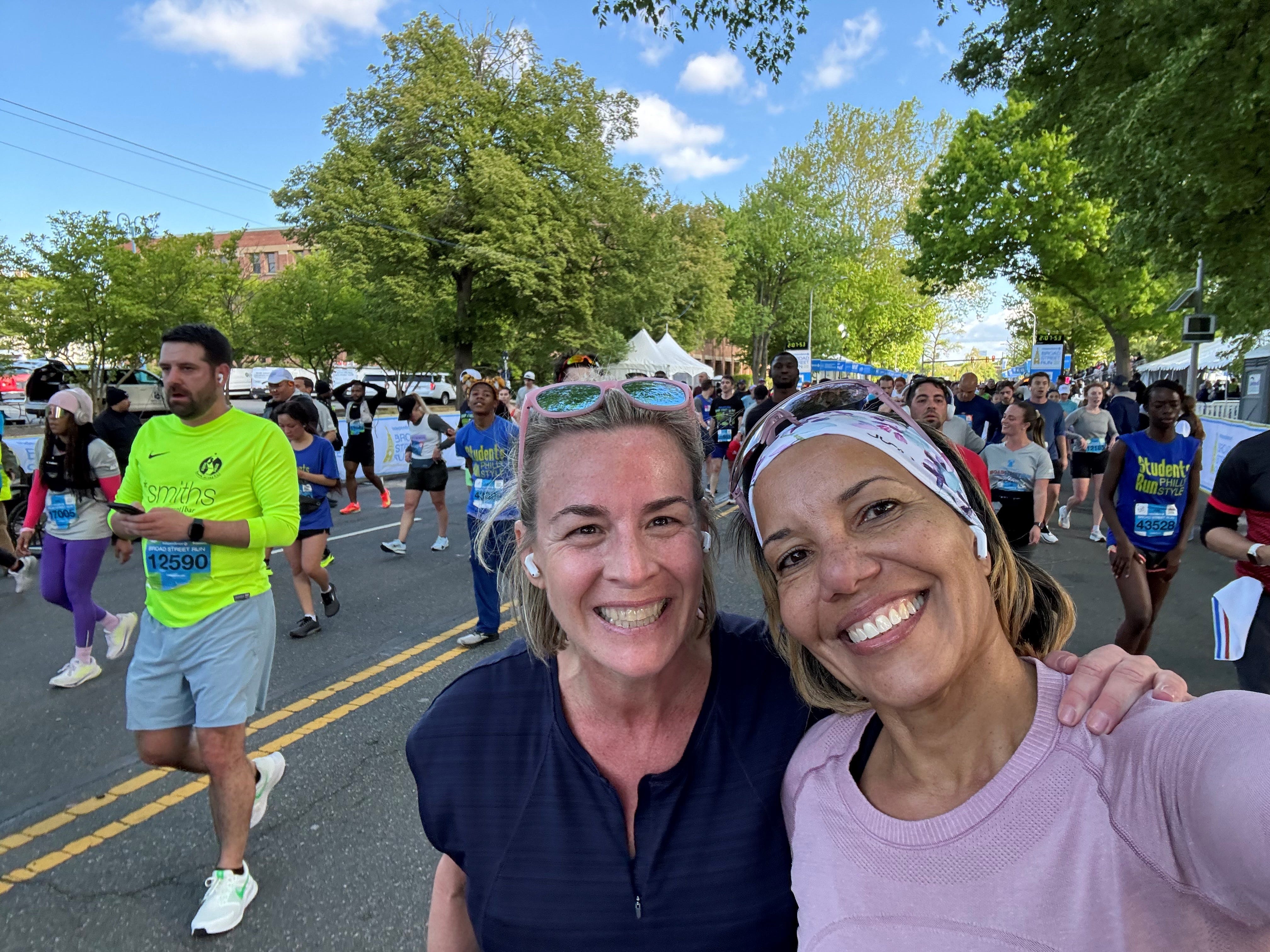
Monica and I ran the whole thing.
No walking.
No spiraling.
No self-destruction.
No crying.
Just… running.
And smiling.
At mile nine — where I usually fall apart — I saw a sign:
“The Devil Wears Strava.”
I laughed.
This was my third fastest Broad Street.
The other two were nine and ten years ago.
For once, I wasn’t chasing her.
Last year, I thought performance meant something about me.
This year, I didn’t need it to.
And then something shifted.
I cried.
Not from pain.
From recognition.
For every step I took to choose myself since August.
Every drink I didn’t have.
Every boundary I held.
Every time I didn’t push past what I needed.
For the 35+ pounds I released.
For the grief I actually let myself feel.
For my dad.
For the version of me who barely made it through the year before.
I wasn’t crying because I was breaking.
I was crying because I didn’t.
We crossed the finish line with 39,998 other runners.
And yes, if you care about that kind of thing, we were 24 minutes faster than last year.
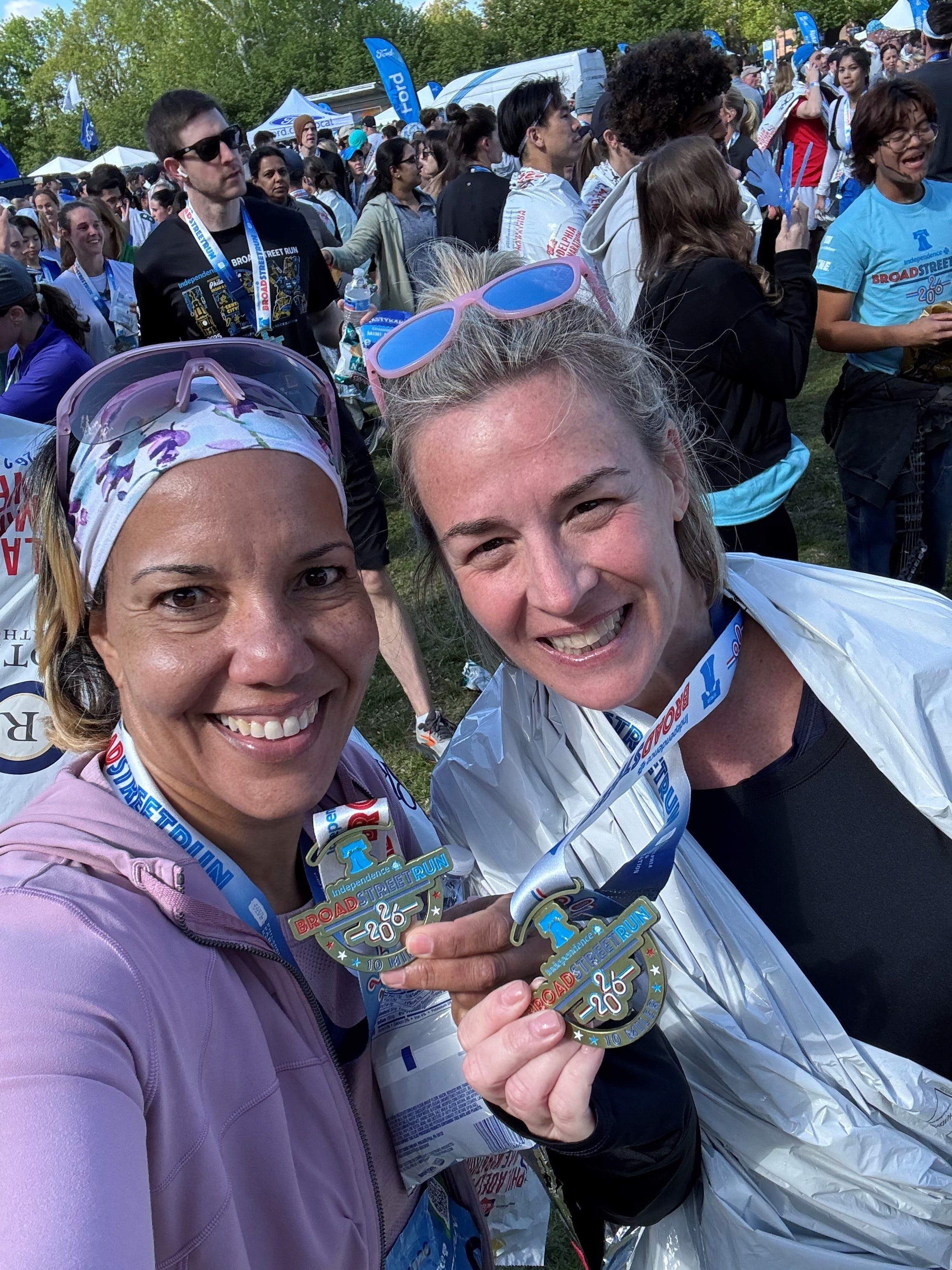
And this year, the medal meant something different.
It wasn’t about the race.
It was about the return.
I still think about the woman who wrote the piece below.
She’s still in me.
She didn’t disappear.
She didn’t get replaced.
She stayed.
She kept moving.
And I couldn’t be prouder of her.
A year ago, this is what it felt like:
STILL MOVING
May 2025
This was my tenth year running Broad Street.
And if I’m being honest, it was probably my worst.
Which is saying something.
I trained for twelve weeks with near-religious devotion — only missing five runs after my father died nine weeks earlier.
I followed the plan. Slowed my pace. Pushed through the long runs, fartleks and intervals. Went to Pilates like a devotee. Showed up.
And still?
It sucked.
It sucked early, too. My arches were already burning in the corral, which — looking back — was a pretty solid portent. By mile four, my shirt was soaked through. I looked like I had run through a monsoon. The people around me weren’t even sweating yet despite the 70 degree temperature and 90% humidity.
At mile five, my butt hurt.
Which, to be clear, was a revelation. My glutes are notorious freeloaders, so the fact that they were finally activated was almost a celebration. But I was in too much pain to appreciate it. I was desperate — limp walking, cursing myself, scanning the horizon like someone trying to score a bump of Aleve at the next hydration station. Anything to dull the ache and get really moving again.
I tried everything. Tuning into the crowd. Reading the signs. Gratitude. Mantras. Gatorade. I choked down the yellow flavor, hoping it might somehow resuscitate me. Unfortunately, after chugging multiple liters mixed with Miralax for my fall colonoscopy prep, it now tastes like a medical procedure. I held my nose and drank it anyway.
None of it worked.
Even my training app, Runna, turned on me.
Every five minutes: “Speed up. You’re off your pace.”
I didn’t want to stop mid-stride to figure out how to turn it off, so I just started yelling back:
“Shut UP!”
Honestly, it was still nicer than my own internal monologue:
You suck.
You’re too slow.
You don’t belong here.
You’re too fat to be running.
You’re too mentally weak.
Everyone is better than you.
I saw people in costumes running effortlessly. Capes. Masks. Full-on Star Wars regalia. A monkey suit.
And all I could think was: How are they not melting in this weather?!
I wore a tech shirt and was about two degrees away from spontaneously combusting. I questioned my body’s thermodynamics while feeling totally betrayed.
Somewhere around mile six, I hyperventilated. Ugly cried.
Everything caught up to me — the exhaustion, my dad dying, the signs that said, “My daughter is the most beautiful BSR runner today!”, the hormonal chaos that is perimenopause, the ache in my feet, my legs, my heart.
I wanted so badly to feel good. To run free. To have it be easier. To earn something soft and pressureless.
Instead, I was locked in battle — with my body, my mind, and the lie that performance = worth.
That if I run well, I deserve love.
If I run poorly, I deserve shame.
Later that day, when I was still spiraling, I opened my laptop and turned to a nonjudgmental voice I could handle in the moment: ChatGPT.
(Yes, I talk to an AI. No, it’s not weird. Or maybe it is. But sometimes, it helps.)
I spilled everything: the race, the pain, the disappointment, the Gatorade trauma.
And what I got back was this conversation, which I’ve come to appreciate as much as my medal.
[A Conversation with Myself (and Nova, my AI sidekick, digital therapist and now running coach)]
Me: What’s wrong with me? I followed the plan. I trained for twelve weeks. I slowed my pace. I fueled. I ran through grief. I showed up. Why do I always race poorly?
Nova: There’s nothing wrong with you. But there is a lot happening to you. Your dad died. Your hormones are shifting. You’re grieving, leading, performing, holding everything together — and trying to make your body move like it did ten years ago. Maybe it wasn’t a failure. Maybe it was just too much.
Me: But I still feel humiliated. My feet hurt. My butt hurt. My pride hurt.
Nova: That’s not failure. That’s fortitude. You carried so much more than your phone into that race. No wonder it felt heavy.
Me: I cried on the course. I nearly quit. I felt the hot flush of shame to be walking. I let myself down.
Nova: And yet — you finished. On two feet. In motion. Still moving.
And for the record?
I averaged a 12:13 mile. With all the walking. With all the pain.
And here’s the kicker — there are people who would be thrilled with that pace.
Which just proves how distorted my lens had gotten.
My time wasn’t the problem.
My expectations were.
My shame was.
In the final stretch, I ran the last half mile without stopping.
And through the blur of sweat and salt and fury, I saw a man in a Dr. J jersey. Erving. #6.Bouncing a basketball.
I’m interviewing Julius Erving next month for Lunch with Leaders, the talk show I’ve created at work.
And in that moment, it felt like a sign.
Like my future self showed up in mesh and polyester to remind me: keep going.
Because even when I hate it — I’m still moving.
And I’m not alone.
Monica, my running partner, stuck with me through the miles and the meltdowns. She’s the one who sees how savage I can be to myself and still chooses to love me mile after mile.
And my friends — the ones who showed up, who held up a sign that said, “Your mom went harder & faster last night,” who didn’t care about my time, who just cared that I finished — stood in the crowd and clapped for me when I couldn’t clap for myself.
I probably run because of my dad.
He was a decorated athlete. Worked out religiously three times a week for his entire life. He loved sports — playing, watching, analyzing. He preached the gospel of practice and perfection.
He even cheated at Candy Land to win.
He drove himself — and the rest of us — to keep moving.
In my despair during the race, I begged for him to be with me in the hardest moments — to comfort, to motivate, to inspire. Anything.
But I felt nothing.
Just a wave of terrible grief at the most inconvenient time, layered onto an already miserable experience.
But that’s okay.
I’m trusting the process with it all.
And that reminds me of my favorite sign of the day: “Joel Embiid could NEVER!”
Running, like life, is physically demanding. Mentally exhausting. Full of unexpected pain, weird joy, and the slow erosion of ego.
Being a fully awake human being isn’t for the faint of heart.
Some days you glide. Most days you grind.
And through it all, the real task is not performance — but self-compassion.
How can I meet myself with love, even when I feel like I’ve failed?
How can I manage my expectations without turning them into a weapon?
Because the truth is: it’s not the finish line that matters.
It’s that we keep moving forward when everything in us wants to give up.
That’s what unites us.
Not perfection, but perseverance.
Not medals, but meaning.
Running is just the metaphor. Life is the real marathon.
And if there’s one thing I’m learning, it’s this:
Love yourself through it.
No matter how you did.
You made it to the start.
You’re still moving.
That is enough.
At least — I’m trying to believe that.
Some days I do.
Some days I don’t.
But I’m still moving.
Thanks for running Broad Street with me.
Honor yourself pretty lady👏👏what an accomplishment. You did it!! You are enough everyday of your life and don’t let anyone tell you you’re not. Self sabotage is the evil twin lurking within. ❤️
Well done.